
Case study · AU Design US
Rebuilding a drafting company's website around clearer services, stronger evidence, and measurable acquisition paths.
PageUP planned, wrote, and built a fourteen-page Divi 5 website for AU Design US—organizing a specialized service range into clearer visitor paths, authentic project evidence, consistent inquiry flows, and a measurement foundation for search and advertising.
Strategy, content, implementation, assets, analytics, advertising infrastructure, DNS/CDN coordination, and launch stewardship.
14core pages
one connected website
- Service architecture
- residential, commercial, as-built and scanning, CAD and technical drafting;
- Evidence and conversion
- service-specific proof, Project Experience, and a consistent inquiry path; and
- Measurement and acquisition
- analytics, form conversion, search visibility, and relevant advertising destinations.
Website Strategy · Content Architecture · Divi 5 · Project Assets · Analytics · Google Ads · Launch
The operating context
AU Design US works across residential and commercial drafting, existing-condition documentation, field capture, CAD production, technical drawings, and visualization. A homeowner planning an addition does not begin with the same question as a contractor coordinating a finish-out, a property owner documenting an existing building, or a vendor requesting shop drawings.
The website needed to help each visitor recognize the appropriate service, understand what information or fieldwork might be required, inspect relevant examples, and begin a useful inquiry. It also needed to preserve important boundaries around engineering, permitting, governmental review, and project-specific scope.
- new homes, additions, and remodeling;
- commercial finish-outs and change of use;
- as-built documentation and 3D field capture;
- CAD production and file conversion;
- structural, mechanical, and shop-drawing support;
- renderings and project visualization.
The first design problem was not visual style. It was making a broad technical service range understandable without making promises the business could not responsibly make.
When licensed engineering is required, it is provided by independent licensed firms contracted by the client.
The responsibility
PageUP's assignment extended from discovery through launch. The site needed a coherent information architecture, page-specific copy, authentic visual evidence, responsive implementation, inquiry paths, search and analytics foundations, advertising destinations, and technical coordination across WordPress, forms, DNS, CDN, and browsers.
A dependable result meant more than publishing pages. Visitors needed to reach the right service and understand the next step. AU Design US needed a maintainable system rather than fourteen unrelated layouts. Measurement had to be available before future performance claims could be evaluated. Launch issues had to be owned and resolved across system boundaries.
- one clear route for each major service intent;
- consistent but non-generic page structure;
- authentic project evidence matched to the relevant service;
- accurate scope and consultant boundaries;
- one coherent quote-request experience;
- responsive and accessible production behavior;
- analytics and form-conversion foundations;
- relevant destinations for paid-search traffic;
- documented launch verification and recovery.
PageUP's scope
- Strategy and content architecture
-
- service discovery and positioning;
- fourteen-page sitemap and visitor-path design;
- page-level content strategy and copy;
- scope, permit, approval, and engineering boundary language;
- internal linking and inquiry-path planning.
- Visual and responsive implementation
-
- Divi 5 production build;
- reusable section and page patterns;
- separate desktop and mobile Smart Slider hero compositions;
- responsive layout, typography, and navigation behavior;
- forms, buttons, anchors, and project-sample interactions.
- Authentic project evidence
-
- source review and curation;
- purpose-composed hero assets;
- optimized WebP production;
- meaningful image descriptions and captions;
- service-specific project examples and a dedicated Project Experience page.
- Search, measurement, and acquisition paths
-
- on-page SEO fields and internal linking;
- Search Console and sitemap coordination;
- GA4 and Tag Manager configuration;
- form-conversion and attribution foundations;
- Google Ads group and destination restructuring.
- Launch and continuity
-
- DNS and Cloudflare coordination;
- browser and protocol troubleshooting;
- launch checks and issue resolution;
- coordination with US As Built and the broader four-site strategy.
This case study describes PageUP's documented website, measurement, advertising-infrastructure, and launch responsibilities. It does not assign PageUP responsibility for AU Design US's professional services, engineering consultants, governmental decisions, project outcomes, or every future site in the broader brand strategy.
Architecture before decoration
-
Separate distinct visitor intents
Residential, commercial, existing-condition, scanning, CAD, technical-drafting, shop-drawing, and rendering needs were given distinct routes instead of being compressed into one general services page.
-
Use consistent page logic without repeating one template mechanically
Each service page explains who the service is for, what the work may include, what information shapes the scope, where responsibility changes, and how to begin. Reusable patterns create consistency while page-specific copy and evidence preserve meaning.
-
Put authentic work where it answers a question
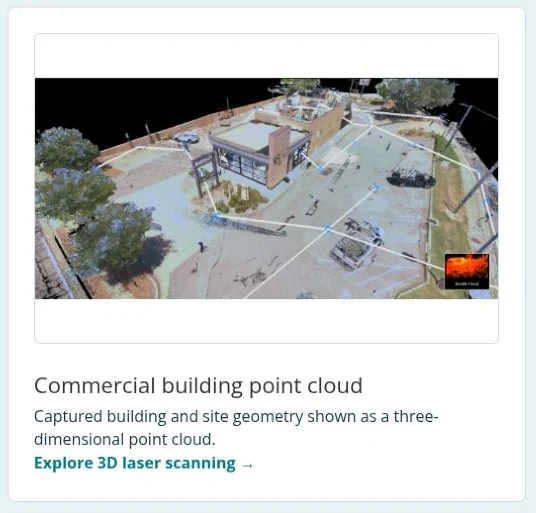
Plans, elevations, renderings, point clouds, field-capture examples, and technical sheets support the relevant service. The Project Experience page provides a broader collection without turning every service page into the same gallery.
-
Connect acquisition to the right destination
Internal links, form paths, analytics, search metadata, and selected Google Ads destinations were aligned with page intent so future measurement can distinguish which paths visitors use.
From source material to production
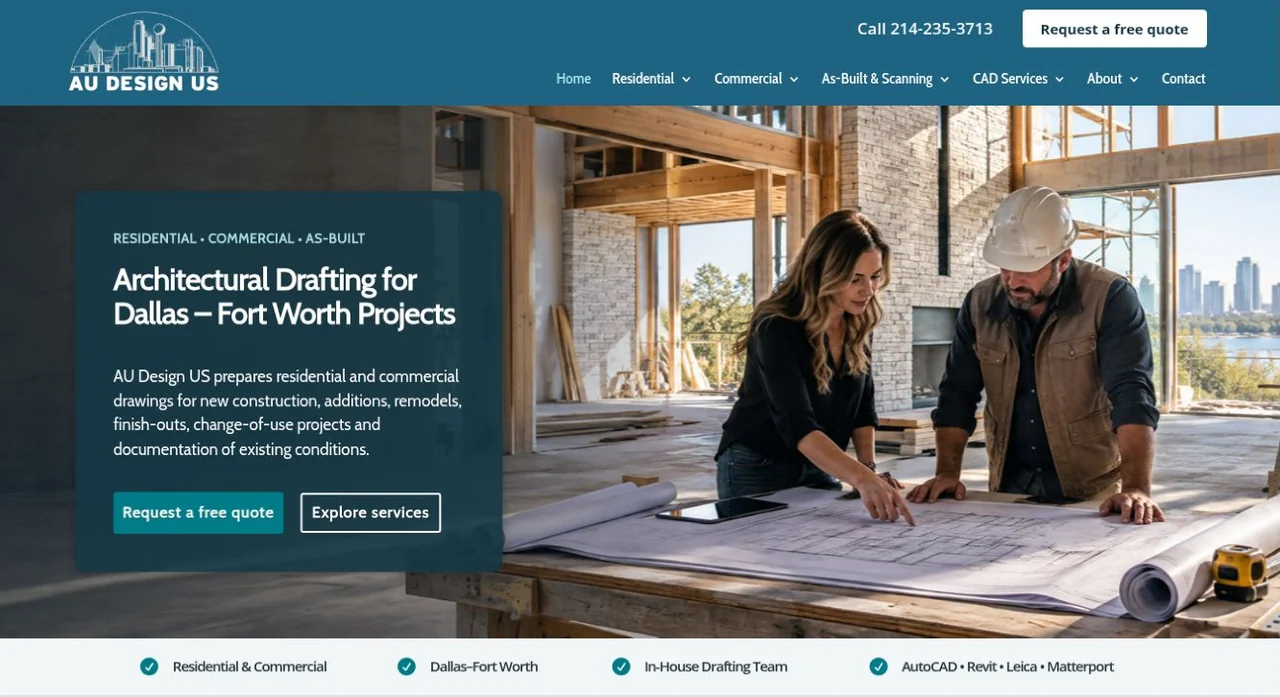
PageUP reviewed existing business material, service details, project drawings, scans, renderings, and talking points, then developed page-specific content and visual compositions around the work AU Design US actually performs.
The production build used Divi 5 for the page system and Smart Slider for purpose-composed responsive heroes. Project assets were reviewed, cleaned where necessary, resized, converted to appropriate WebP derivatives, described, and placed according to the service they help explain. The resulting public Project Experience collection organizes residential, commercial, as-built and scanning, and CAD and technical-drafting samples.
-
Clear service pages
each major service has a defined destination and project-specific explanation.
-
Authentic visual material
plans, renderings, scans, and technical sheets come from supplied work rather than generic stock graphics.
-
Responsive compositions
desktop and mobile heroes were composed separately where one crop could not serve both contexts.
-
Relevant project routing
service pages and project samples lead toward the same quote-request system.
-
Maintainable implementation
reusable Divi 5 patterns support consistent updates without erasing page-specific meaning.
Measure before making claims
-
Relevant entry
search or advertising can lead to the service page that matches the visitor's intent.
-
Service evidence
the page explains the work, its boundaries, and relevant examples.
-
Inquiry path
consistent calls to action lead to a structured quote request with optional supporting-file uploads.
-
Conversion record
GA4 and Tag Manager provide the foundation for form-conversion and source measurement.
-
Future evaluation
sufficient clean data, a defined period, and client approval are required before public performance claims are made.
After the rebuild, PageUP aligned selected Google Ads groups with dedicated service destinations, paused outdated ad variations, and corrected the conversion-measurement path around GA4. Search Console, sitemap, analytics, and recrawl work created a cleaner foundation for observing what happens next.
Those changes are implementation evidence, not a result claim.
This work establishes the website and measurement foundations for evaluating acquisition performance over time.
Responsibility through launch
Publication required coordination beyond the page builder. PageUP managed DNS and Cloudflare changes, verified the production site, and investigated a browser-specific connection failure that appeared after launch. The issue was traced to problematic HTTP/3 behavior; PageUP disabled that path while retaining HTTP/2 and restored dependable browser access.
That work is part of the case study because a website is not complete merely because its layouts are saved. DNS, CDN behavior, forms, analytics, redirects, browsers, and public access all participate in the production result.
- rebuilt site launched September 17, 2026;
- DNS and CDN coordinated;
- browser-specific protocol failure diagnosed;
- stable protocol path retained;
- forms, public pages, analytics, and search foundations checked;
- recovery and continuation material maintained.
Related PageUP work
Start with what the website must clarify
If a website has to explain several services, support real evidence, create useful inquiry paths, and connect to measurement or advertising, the work should begin with the operating and visitor decisions—not a collection of page templates.