
Crown Pools · Website, AI and growth systems
Building a practical AI consultant around real products, locations, and customer questions.
PageUP designed and built a production AI consultant for Crown Pools that connects business-specific knowledge, live product and page context, location rules, customer questions, campaign attribution, and an established human follow-up process.
A client relationship spanning more than ten years across website development, consulting, Google Ads, and continuing technical work.
Website · Business knowledge · Practical AI · Ecommerce context · Lead operations · Continuing support
From question to responsible next step
- Customer question
- Grounded Crown Pools knowledge
- Controlled product, page, address, location, or campaign context
- Bounded answer or qualification
- Consented lead or human handoff
The operating context
Crown Pools serves North Texas customers across custom inground pools, Stealth pool options, above-ground pools, remodeling and repair, hot tubs, supplies, equipment, chemicals, cleaners, parts, and accessories. Its public website connects that range to three locations in Dallas, Allen, and DeSoto.
A customer may arrive with a broad planning question, a product question, a pool-care concern, an address, a preferred location, or interest in a future project. Useful guidance depends on what Crown Pools actually offers, what page or campaign brought the visitor in, which information can be stated confidently, and when a person should take over.
The challenge was not to make AI sound knowledgeable about pools. It was to make the experience useful within Crown Pools's actual business context.
Customer-question landscape
- pool types and project options;
- products, equipment, supplies, and care;
- pricing context without invented quotes;
- locations and service-area relevance;
- remodeling, repair, and next-step questions;
- readiness for consultation or human follow-up.
The responsibility
The consultant needed to answer defined questions using Crown Pools-specific information, connect to current website and product context, recognize location and address relevance, and help interested customers move into the existing lead process.
It also needed clear limits. The system should not invent availability, exact pricing, discounts, unsupported product options, diagnoses, or service-area promises. It should distinguish guidance from confirmation, obtain permission before creating a lead, preserve acquisition and campaign attribution, distinguish AI-created leads from visitor-completed AI Assisted Conversions, and give Crown Pools staff enough context for an informed follow-up.
A dependable result
- useful answers grounded in Crown Pools information;
- controlled access to current business context;
- explicit guardrails around unsupported claims;
- consent before follow-up;
- structured lead creation rather than an untraceable conversation;
- retained source attribution when a visitor completes the regular lead form after interacting with the consultant;
- visible human ownership of the next step;
- review, testing, documentation, and maintainability after launch.
PageUP's scope
- Website and customer context
-
- Crown Pools website development and continuing technical support;
- page and campaign context available to the consultant;
- public placement and customer entry experience.
- Knowledge and response architecture
-
- defined use cases and customer questions;
- Crown Pools-specific knowledge retrieval;
- response boundaries and human-confirmation language;
- continuing knowledge review and maintenance.
- Products, locations, and business tools
-
- live WooCommerce product information and product-page context;
- address resolution;
- location and service-area logic;
- controlled tool behavior and fallback paths.
- Lead and follow-up operations
-
- explicit follow-up permission;
- project and contact-detail collection;
- Gravity Forms lead creation;
- routing, attribution, AI-generated conversation summary, and existing notifications;
- built-in interaction analytics that retain visitor source and campaign context;
- AI Assisted Conversion classification when the visitor—not the AI—submits the regular lead form after an interaction.
- Production responsibility
-
- guardrail and exception-path testing;
- analytics and logging controls;
- deployment validation;
- documentation;
- maintenance and continuing refinement;
- monthly training and refinement based on reviewed interaction logs.
- Broader relationship
-
- ongoing consulting;
- Google Ads management;
- coordination between customer acquisition, website context, and follow-up responsibility.
The consultant is one part of a broader, long-term technical relationship. This case study describes PageUP's documented responsibilities without implying ownership of every Crown Pools sales, service, advertising, or operational function.
How the system is structured
- Purpose
- Support defined customer questions and next steps. The consultant is not presented as a general pool authority or autonomous salesperson.
- Grounded knowledge
- Use controlled Crown Pools-specific information so answers begin with the business's actual products, services, policies, and operating context.
- Live tools and context
- Bring in WooCommerce product information, page context, campaign and acquisition-source context, address resolution, and location logic only through defined tools and rules.
- Guardrails
- Restrict unsupported claims about availability, exact pricing, discounts, diagnoses, options, and service areas; make confirmation boundaries visible.
- Consent and human handoff
- Request explicit permission before the AI creates a lead, then preserve the question, relevant details, source context, and conversation summary for staff follow-up. Separately preserve source context when an interacting visitor chooses to submit the site's regular lead form.
- Review and maintenance
- Validate deployment, review response behavior, control logs and analytics, document the implementation, and maintain knowledge and integrations as the business changes. Each month, review logged interactions and train or refine the consultant to address recurring questions, knowledge gaps, weak answers, and changing business information.
OpenAI's Responses API, controlled retrieval, WooCommerce, Google Places, Gravity Forms, and the existing WordPress environment support the implementation.
From question to responsible next step
Ordinary guidance path
- The visitor asks a question. The consultant receives the question with available page and campaign context.
- The system identifies relevant knowledge or a controlled tool. It may use Crown Pools information, current product context, an address, or location logic.
- The consultant provides bounded guidance. The response answers what can be supported and identifies what requires confirmation.
- The visitor chooses whether to continue. Follow-up information is not treated as permission by default.
- The visitor chooses a conversion path. With explicit permission, the AI can create a structured Gravity Forms lead with source context, routing information, and a conversation summary. The visitor may instead submit the site's regular lead form after the interaction.
- Analytics preserves the distinction. A visitor-completed regular form submission following a consultant interaction is classified as an AI Assisted Conversion, preserving its acquisition source without describing the AI as the form submitter.
Two distinct conversion paths
- AI-created lead
- After explicit permission, the AI workflow creates a structured Gravity Forms lead for human follow-up.
- AI Assisted Conversion
- After interacting with the consultant, the visitor submits the regular site form. Analytics preserves the acquisition source; the AI does not submit the form.
Exception and boundary paths
- If the requested fact is unavailable or uncertain, the consultant should say so rather than invent it.
- If exact pricing, availability, diagnosis, discount, or service eligibility requires staff confirmation, the system should hand off.
- If an address or location does not produce a supported conclusion, the system should avoid making a service promise.
- If the visitor does not consent to follow-up, the system should not create a lead merely because a conversation occurred.
- If the visitor independently submits the regular site form, the resulting conversion should retain the interaction and acquisition context without being mislabeled as an AI-submitted lead.
A useful production path includes the places where the system declines, qualifies, or hands responsibility to a person.
What can be observed
Live public evidence
Visitors can open the Crown Pools website and use the AI Pool Consultant where it is deployed. The public interface identifies the experience, describes the questions it can help with, and states that AI-generated information may require Crown Pools confirmation.
Implementation evidence
- a live production entry point on the client website;
- business-specific knowledge and controlled retrieval;
- WooCommerce, page, campaign, address, and location context;
- consented Gravity Forms lead creation and routing;
- acquisition and campaign attribution, conversation summaries, and existing notifications;
- AI Assisted Conversion tracking when an interacting visitor later submits the regular lead form;
- monthly training and refinement based on reviewed interaction logs;
- documented guardrails, testing, deployment validation, analytics, and maintenance responsibilities.
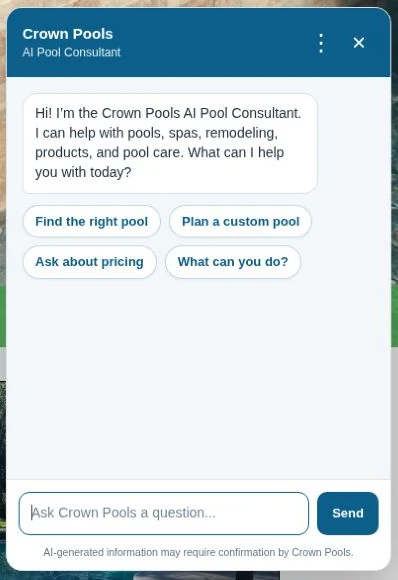
The public consultant entry, before a visitor asks a question. Screenshot captured September 24, 2026.
Responsible outcome
The delivered system has completed end-to-end production lead flows and generated real customer inquiries. Its analytics distinguish leads created through the consented AI workflow from AI Assisted Conversions completed by visitors through the regular lead form after an interaction. Those classifications describe how inquiries are created; they do not by themselves measure incremental lift or business impact.
Designed limits are part of the work
The public experience is designed to help customers explore Crown Pools information and reach an appropriate next step. It is not represented as a source of guaranteed availability, exact quotes, professional diagnosis, discounts, final service-area determinations, or error-free output.
Crown Pools remains responsible for confirming business decisions and customer commitments. PageUP remains responsible for the documented application architecture, implementation, testing, deployment, and continuing technical work within the engagement.
Customer privacy
This case study uses the public consultant experience to explain the work. Customer conversations, contact details, lead records, and private system information are not published. No quantified business-performance results are presented.
Beyond the initial deployment
PageUP's work with Crown Pools extends beyond the initial AI release. The broader relationship includes website development and technical support, consulting, Google Ads management, deployment and integration maintenance, and ongoing monthly training and refinement of the consultant as products, knowledge, customer questions, pages, campaigns, and business needs change.
Continuity does not mean that every part of the system changes constantly. It means responsibility for the implemented experience remains close enough to the business to review behavior, correct problems, update grounded information, maintain connections, and make deliberate improvements.
Continuing responsibility
- knowledge and business-rule updates;
- product, page, location, and campaign changes;
- integration maintenance;
- response and exception-path review;
- monthly review of logged interactions to identify knowledge gaps, recurring questions, weak answers, and required training or refinement;
- deployment and compatibility verification;
- website, consulting, and advertising coordination where responsibilities intersect;
- acquisition-source continuity from Google Ads interaction through AI-created or visitor-completed conversion paths.